
Aircraft Engine Leaning Explained: From Basic Mixture Control to Advanced Leaning Techniques
Aircraft engine leaning is one of the most misunderstood topics in aircraft ownership and operation. The reasons are multi-layered, but certainly include a lack of knowledge, proper guidance, and the persistence of inherited rules of thumb and old wives’ tales.
Why Is Leaning Still So Poorly Understood?
Aircraft engine leaning has historically been taught and handled rather poorly. We are operating engines whose basic designs date back decades, but many aircraft now have instrumentation their original operators could only have dreamed of. We can see individual-cylinder EGTs and CHTs, fuel flow, and temperature trends in real time.
Unfortunately, our operating practices, concepts, and knowledge have not kept pace with advances in instrumentation and our growing understanding of how these engines operate. Many pilots and aircraft owners therefore have access to considerably more information while still operating their engines according to practices that originated in the 1960s and 1970s.
Ask ten pilots how they lean their engine and you may get ten different answers.
Some never touch the mixture below 5,000 feet density altitude. Some lean until the engine runs rough and then enrich slightly, without necessarily knowing whether they are operating rich or lean of peak. Some religiously operate rich of peak and even add a little more fuel just to be “safe.” Others are afraid that pulling the red knob too far will damage the engine. And relatively few routinely operate lean of peak.
Proper engine leaning therefore remains something of a mystery for many pilots and aircraft owners. The problem is compounded by aircraft and engine operating manuals that are often outdated, along with training syllabi and curricula that have not kept pace with the knowledge and instrumentation now available to us.
Prefer to watch instead of read?
The “Don't Lean Below 5,000 Feet” Mental Model
Most pilots have learned an altitude-based mental model: Below X altitude = full rich. Above X altitude = lean.
This mental model is useful for beginners and student pilots, but it is oversimplified and should be developed further as we progress in our general aviation journey.
As altitude increases, air density decreases. While the proportion of oxygen in the atmosphere remains approximately the same, a given volume of air contains less air mass and therefore less oxygen. If the fuel flow remains unchanged, the fuel-air mixture becomes progressively richer. It is therefore correct that we need to lean, or reduce fuel flow, as we climb.
The problem is that altitude itself is not what we are trying to manage. It is simply one of the conditions affecting what we are actually managing: the fuel-air mixture and ultimately the combustion process.
Why Do We Have to Manually Lean in the First Place?
Not every aircraft engine requires the pilot to manually control the fuel-air mixture. Many modern engine installations manage fuel flow automatically, either mechanically or electronically, and therefore do not have a conventional mixture control.
This includes many Rotax-powered aircraft, diesel engines, and engines equipped with FADEC or other electronic engine-management systems. The technical solutions differ, but from the pilot’s perspective the important point is simple: the engine-management system adjusts the fuel flow without requiring the pilot to manually compensate for changing operating conditions.
Many traditional Continental- and Lycoming-powered aircraft are different. Unless equipped with an automatic engine-management system, such as the Lycoming TEO-540 with its integrated electronic engine control, the pilot controls the mixture manually. As air density, power settings, and operating conditions change, the pilot has to adjust the fuel flow accordingly.
In other words, if your Continental- or Lycoming-powered aircraft has a conventional mixture control, you are part of the engine-management system.
That is why understanding mixture management matters. The red knob is not simply another control to position according to a memorised altitude or checklist item. It gives the pilot direct influence over the fuel-air mixture and therefore the combustion process inside the engine.
Why Mixture Management Is Often Oversimplified
If mixture management is such an important part of operating a traditional Continental- or Lycoming-powered aircraft, why do so many pilots leave flight training with only a basic understanding of it?
Part of the answer lies in the purpose of flight training itself. Flight schools and instructors primarily need to teach students how to operate an aircraft safely and competently and meet the requirements of the respective licence or rating. They are not necessarily trying to develop knowledgeable long-term aircraft owners. In that environment, simplifying a complex subject such as mixture management is understandable. A rule such as “don’t lean below 5,000 feet” is easy to teach, easy to remember, and unlikely to overwhelm a student who is already learning to fly the aircraft.
The problem is not necessarily the simplification itself. The problem is when that simplified model is never developed further.
There are other factors as well. Particularly in Europe, many flight schools operate Rotax- or diesel-powered aircraft that do not require conventional manual mixture control. An instructor can therefore accumulate considerable flight-training experience without necessarily accumulating equivalent experience in mixture management on traditional Continental- and Lycoming-powered aircraft.
Experience alone can also be misleading. Younger instructors may have relatively limited experience with aircraft ownership and may see instructing primarily as a step towards a professional flying career. At the other end of the spectrum, highly experienced professional pilots may have thousands of hours in turboprop or turbofan aircraft without necessarily having extensive experience managing traditional piston engines. Neither situation makes someone a bad instructor. It simply means that total flight time and piston-engine ownership experience are not the same thing.
There is also a difference in incentives and time horizons. The instructor needs to teach the student to operate the aircraft safely. The pilot-owner, however, has to live with the long-term consequences of how that aircraft and its engine are operated. Reliability, maintenance, fuel consumption, engine condition, availability, and ultimately the longevity of the asset become much more important when you own the aircraft yourself.
This is where the distinction between learning to operate an aircraft and learning to own one becomes important.
Many pilots learn what to do with the mixture control without ever really learning what they are trying to achieve by doing it. They may leave it full rich, follow a fuel-flow figure from the POH, or use a leaning procedure they were taught years ago without understanding the underlying combustion process or how to interpret deviations from the expected result.
And that is really where proper mixture management begins. Before discussing rich of peak, lean of peak, EGT, CHT, or any particular leaning technique, we first need to understand what moving the mixture control is actually doing inside the engine.
What the Mixture Control Is Actually Doing
Before discussing rich of peak, peak EGT, or lean of peak, we need to briefly look at the combustion process and understand what we, as pilot-owners, are actually influencing when we move the mixture control.
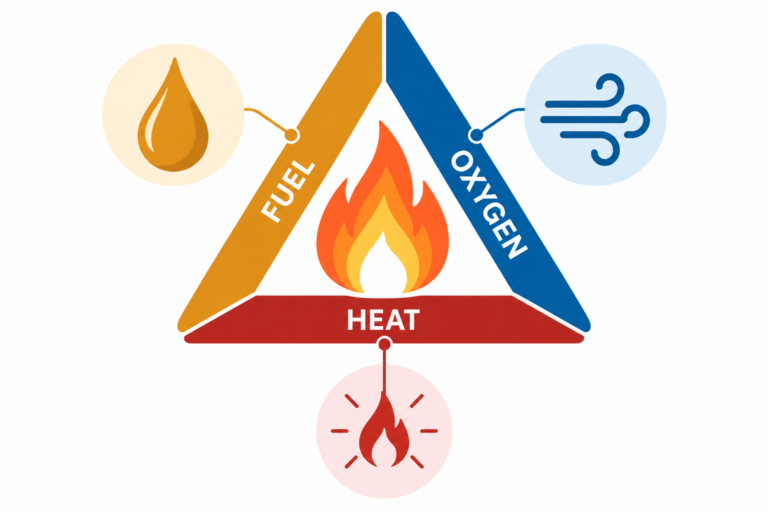
At its most basic level, combustion requires three things: fuel, oxygen, and a source of heat or ignition. This is commonly illustrated by the fire triangle.
In our gasoline-burning aircraft engines, fuel and air need to be mixed in the correct proportions for combustion to take place. The theoretical mixture at which there is just enough oxygen to completely burn the available fuel is called the stoichiometric mixture. For gasoline, this is approximately 14.7 parts air to one part fuel by mass, although the precise value depends on the composition of the fuel.
A mixture containing more fuel relative to the available air is referred to as rich, while a mixture containing less fuel relative to the available air is referred to as lean.
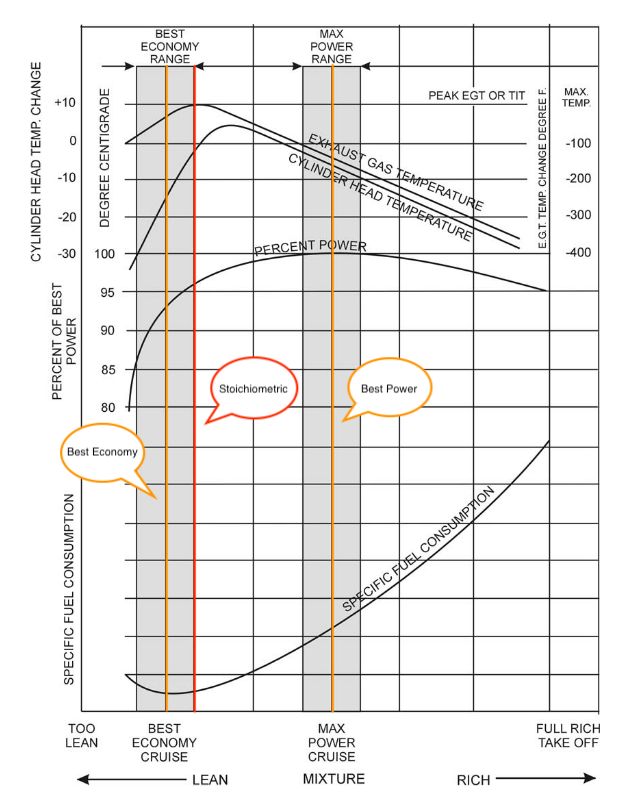
This is useful for understanding the underlying combustion process, but we obviously don’t measure the air-fuel ratio directly while flying. Instead, one of the parameters available to us in the cockpit is exhaust gas temperature, or EGT. As we progressively lean the mixture from the rich side, EGT generally increases until it reaches a maximum, which we call peak EGT. If we continue leaning beyond that point, EGT begins to decrease again.
Peak EGT therefore gives us a practical reference point. A mixture richer than peak EGT is referred to as rich of peak (ROP), while a mixture leaner than peak EGT is referred to as lean of peak (LOP).
Importantly, the mixture that produces peak EGT is not necessarily the mixture that produces maximum power or the best fuel economy.
Maximum power is generally achieved with a mixture richer than peak EGT. Best economy, on the other hand, occurs at a leaner mixture. This relationship can be seen in the following illustration from a Lycoming engine operator’s manual.
This distinction is important because there is no single mixture setting that is optimal for every operating condition or objective. Sometimes we want maximum power. At other times we may prioritise fuel efficiency, lower temperatures, or reduced engine stress.
That is why we need to understand what happens when we move the mixture control. We are not simply adjusting fuel flow to save fuel. We are controlling the combustion process.
By changing the fuel-air mixture, we influence power, fuel consumption, temperatures, combustion characteristics, and ultimately how the engine operates. Understanding those relationships allows us to choose an appropriate mixture for what we are trying to achieve during a particular phase of flight.
Rich of Peak or Lean of Peak?
Generally speaking, we can opt to fly either lean of peak or rich of peak. Previously, people often talked about lean and rich even if they stayed on the rich side of peak EGT. This is partly because manufacturers have historically indicated that best economy can be achieved approximately 20°F to 50°F rich of peak for certain engines and operating conditions.
Unfortunately, this is also an area where cylinder head temperatures and internal cylinder pressures can be particularly high. Cylinder head temperature is not a direct measurement of internal cylinder pressure, but it is one of the most useful parameters available to us in the cockpit for monitoring the thermal condition of the cylinders and how the engine is being operated.
So, if we want to achieve good fuel economy while reducing cylinder head temperatures and internal engine stress, we should consider operating lean of peak, provided the engine, installation, power setting, and manufacturer limitations permit it. Approximately 0°F–50°F lean of peak is generally the area we are interested in.
Unfortunately, not all engines can be operated smoothly lean of peak because of uneven fuel-air distribution among the cylinders. That said, suitable fuel-injected engines can often be upgraded with calibrated fuel injectors, such as GAMIjectors, to improve the fuel-air distribution between cylinders and enable smoother lean-of-peak operation.
Why would we want to run the engine lean of peak in the first place? Because it is more fuel-efficient, puts less thermal and mechanical stress on the engine through lower internal cylinder pressures and cylinder head temperatures, and a leaner mixture burns cleaner than an unnecessarily rich mixture. This can reduce lead and carbon deposits on vital components such as spark plugs, combustion chambers, and exhaust valves, which in turn can contribute to longevity and reliability while reducing fuel and maintenance costs.
Temperature Management
Aircraft engine leaning is largely about temperature management, but the critical parameter is not simply exhaust gas temperature. In fact, there is no EGT limit specified in the operator’s manuals for many Continental- and Lycoming-powered engines. EGT is primarily used as a reference during the leaning process, which is why we talk about peak EGT, rich of peak, and lean of peak.
Cylinder head temperature is particularly important because it gives us an indication of the thermal condition of the cylinders. While CHT cannot be translated directly into internal cylinder pressure, high CHT can indicate that the engine is being operated under high thermal stress.
The beauty of lean-of-peak operation is that we can reduce cylinder head temperature by reducing fuel flow. This is quite different from rich-of-peak operation, where we generally need to add a lot of fuel to achieve a similar reduction in temperature.
Don’t believe me? Just review the diagram above. You will notice that the CHT curve falls away on both sides of its maximum: on the rich side by adding fuel, and on the lean side by reducing fuel.
For the same manifold pressure and RPM setting, we can therefore reduce fuel consumption by up to approximately 40% compared with a substantially rich mixture, while losing only about 8% of power. The exact relationship obviously depends on the engine, power setting, mixture distribution, and starting mixture, but the principle remains the same: on the lean side of peak, a comparatively small reduction in power can result in a substantial reduction in fuel flow.
Personal Cylinder Head Temperatures
Both Continental Motors and Lycoming specify maximum CHT limits for their engines, commonly up to 460°F and 500°F respectively, depending on the specific engine. However, these limits should not be interpreted as desirable operating temperatures. They are maximum limitations, not operating targets.
As pilot-owners, we therefore prefer to establish more conservative personal CHT limits and operate the engine comfortably below the manufacturer’s maximum whenever possible.
As general guidance, we propose the following:
Continental Motors
Personal maximum CHT: 400°F
Optimal CHT range: 330°F – 380°F
Lycoming Engines
Personal maximum CHT: 420°F
Optimal CHT range: 350°F – 400°F
These are personal operating limits and guidelines, not replacements for the limitations published by the aircraft or engine manufacturer. The applicable POH/AFM and engine operator’s manual always remain the governing references.
Any deviation above the personal optimal range should be monitored and, where appropriate, counteracted. Any increase beyond the personal maximum and towards the manufacturer’s limit should be managed immediately and, if necessary, aggressively.
Elevated cylinder head temperatures can increase the risk of abnormal combustion conditions such as detonation and pre-ignition. Pre-ignition in particular can cause severe engine damage within a very short period of time.
A Practical Leaning Framework
So how do you lean your aircraft engine properly? It depends on the individual phase of operation and what you are trying to achieve.
Generally speaking, the only times full-rich mixture is required or recommended are during a cold engine start and for take-off at mean sea level and standard atmospheric conditions, depending on the engine and installation. During most other phases of operation, the mixture should be leaned, sometimes aggressively.
When operating lean of peak, a fairly quick transition from rich of peak to lean of peak is preferred in order to minimise the time spent in an unfavourable, high-stress operating condition with high CHT and internal cylinder pressure.
Let’s briefly discuss each phase.
Ground Operations
Lean for maximum engine RPM. You can lean very aggressively on the ground because of the low power setting. At these low power settings, the mixture can be leaned substantially without creating the high cylinder pressures and temperatures that concern us during high-power operation.
Proper ground leaning also helps reduce unnecessary fuel consumption and the tendency towards spark-plug fouling and deposits during prolonged low-power operation.
Take-off
For take-off, the appropriate mixture depends on the engine installation and the atmospheric conditions.
- Naturally aspirated engines at mean sea level and ISA conditions: Full rich.
- Naturally aspirated engines above mean sea level and/or above ISA conditions: Lean for the prevailing conditions.
- Turbocharged or turbonormalised engines at ISA conditions: Full rich.
- Turbocharged or turbonormalised engines above ISA conditions: Lean for the prevailing conditions.
For aircraft with a fixed-pitch propeller, lean for maximum RPM during the full-power run-up or take-off power check, as applicable.
For aircraft with a constant-speed propeller, RPM cannot be used in the same way because the propeller governor maintains the selected engine speed. Instead, use EGT as the reference.
The idea is to establish a reference EGT during a full-power take-off at mean sea level and ISA conditions for the particular aircraft and engine installation. When operating above mean sea level and/or above ISA conditions, lean the mixture at take-off power to reproduce that reference EGT.
This compensates for the change in air density rather than simply leaving the mixture full rich because the engine is operating at take-off power.
Climb
During the climb, lean to maintain approximately the reference EGT established during take-off.
In a naturally aspirated engine, manifold pressure decreases as the aircraft climbs and air density decreases. If the mixture remains unchanged, the fuel-air mixture becomes progressively richer. We therefore progressively lean the mixture during the climb to maintain approximately the same EGT.
This does not mean that a particular absolute EGT is universally correct. The reference is the EGT established for the individual aircraft and engine installation under the appropriate take-off conditions.
As always, cylinder head temperatures should be monitored during the climb. If CHT begins to approach your personal maximum, appropriate action should be taken through mixture, power, airspeed, or a combination thereof.
Cruise
At cruise, we usually decide whether we want to go fast (maximum power) or long and economically (best economy).
For maximum power, lean for maximum power, which is generally approximately 75°F–125°F rich of peak.
For best economy, aim for approximately 0°F–50°F lean of peak. Depending on the engine and installation, sometimes only peak EGT or slightly lean of peak may be achievable because of uneven fuel-air distribution among the cylinders and the premature onset of engine roughness. This is particularly relevant for some carburetted engines.
As discussed earlier, not every engine and installation will operate smoothly lean of peak. The objective is therefore not to force an engine to a particular LOP number, but to understand what the engine is doing and operate it accordingly.
Note: The critical parameters to monitor are cylinder head temperature and, where applicable, turbine inlet temperature. EGT is primarily used as a reference to lean the engine, which is why we refer to peak EGT, rich of peak, and lean of peak. CHT gives us an indication of the thermal condition of the cylinders, while turbine inlet temperature is an actual limitation that needs to be observed to protect the turbocharger.
Descent
During descent, adjust the mixture to maintain approximately constant EGT.
As the aircraft descends and air density increases, the mixture becomes progressively leaner if the mixture control remains unchanged. The mixture therefore needs to be progressively enriched to maintain approximately the same EGT.
One of the advantages of lean-of-peak operation is that, during descent, an initially lean mixture generally becomes leaner as air density increases. CHT will therefore tend to decrease rather than increase as a consequence of mixture alone. Eventually, the mixture may become too lean for smooth combustion, which the engine will usually indicate by running rough. At that point, simply enrich the mixture sufficiently to restore smooth operation and approximately the previous EGT.
Approach and Go-Around Considerations
Depending on your capabilities, proficiency, and currency, you may opt to continue the approach with a lean-of-peak mixture. However, you need to be aware that if substantial power is suddenly required, for example during a go-around, the mixture needs to be adjusted accordingly.
If you are uncomfortable managing mixture and power simultaneously during a high-workload situation, transition to an appropriate rich-of-peak mixture before entering the traffic pattern or on a long final. This reduces the number of engine-control changes required should a go-around become necessary.
The important point is not that the mixture must always be full rich for landing. It is that the mixture must be appropriate for the power you may need next.
After Landing
After landing, return to the same principle we used during ground operations: lean aggressively for ground operation, normally by leaning towards maximum RPM at the prevailing low power setting.
This helps prevent unnecessarily rich operation, spark-plug fouling, and deposits while taxiing.
Aircraft engine leaning is not particularly difficult, but it does require some technical understanding and experience with a specific aircraft to do it properly. As long as appropriate power settings are selected, cylinder head temperatures are monitored, and the limitations of the particular engine and aircraft are respected, mixture can be managed confidently without being afraid of the red knob.
On the contrary, not leaning the aircraft engine at all, or adding more fuel than necessary simply to be “safe,” is not necessarily the conservative option. Excessively rich operation can contribute to unnecessary fuel consumption, deposits, spark-plug fouling, and other issues that may affect reliability and operating costs over time.
Like every skill, proper mixture management requires some time and effort to develop. Once you understand what you are trying to achieve and gain experience with your particular aircraft, it becomes increasingly intuitive.
Basic Leaning vs Advanced Leaning
The difference between basic and advanced leaning can mean different things to different people. For me, basic leaning means applying the fundamental principles of mixture management safely without requiring an in-depth technical understanding of the combustion process. Advanced leaning goes further by applying concepts such as the “Red Box” and “Red Fin” and using a deeper understanding of power, mixture distribution, ignition, temperatures, and engine data to manage the combustion process more precisely.
Basic Leaning
Basic leaning is the minimum level of mixture management a pilot-owner should be able to apply safely without requiring in-depth technical knowledge or extensive experience on type. The objective is to give pilot-owners a simple and practical method to improve their engine operation while observing appropriate temperature and engine limitations.
The basics are understanding your personal cylinder head temperature limits and recognising that CHT is one of the most useful parameters available in the cockpit for monitoring the thermal condition of the cylinders. Obviously, power setting also has a significant influence on engine temperatures and stress.
EGT is used during leaning because it provides the reference for determining whether we are operating rich of peak, at peak, or lean of peak. It is generally not a hard operating limit itself, although you should always check the applicable aircraft and engine operator’s manuals. Turbocharged and turbonormalised installations additionally require the applicable turbine inlet temperature limits to be observed in order to protect the turbocharger.
Basic leaning starts on the ground. At low power settings, lean aggressively and use maximum RPM as a practical reference. Every time you make a significant change to the throttle setting during prolonged ground operation, reassess the mixture and lean as necessary.
The same RPM principle can also be useful in flight with a fixed-pitch propeller. With a constant-speed propeller, however, RPM cannot be used as an indication in the same way because, above the governing range, the propeller governor maintains the selected RPM.
In this case, EGT provides the more useful reference. As discussed earlier, establish the appropriate EGT under known reference conditions and use it to guide mixture adjustments as operating conditions change.
During climb and descent, the same basic principle applies: monitor EGT and adjust the mixture progressively rather than leaving the mixture in one position simply because the aircraft is climbing or descending. During descent, remember that increasing air density progressively leans the mixture if the mixture control remains unchanged, so the mixture will eventually need to be enriched to maintain approximately the previous EGT.
For cruise, you do not need to understand every detail of combustion theory before you start managing the mixture more intelligently. Monitor CHT, understand where peak EGT is, respect the limitations of your particular engine and aircraft, and use the procedures we discussed above to select an appropriate rich-of-peak or, where the engine permits it, lean-of-peak mixture.
Often, pilot-owners simply use the cruise power and mixture settings provided by the manufacturer. While this is better than not leaning at all, it is still a fairly basic approach and does not necessarily account for the peculiarities of the individual aircraft and engine. It also provides little guidance for ground operations, changing atmospheric conditions, high-power applications, and transitions between different phases of flight.
The objective of basic leaning is therefore not perfection. It is to move beyond the idea that full rich is the safe default and start managing the mixture deliberately using RPM, EGT, CHT, the applicable limitations, and an understanding of what you are trying to achieve.
Advanced Leaning
Advanced leaning requires a more in-depth understanding of the combustion process, the individual engine installation, and the information provided by the engine monitor.
This is where concepts such as the Red Box and Red Fin become useful. It is also where we start looking more closely at mixture distribution between cylinders, ignition, induction leaks, individual-cylinder behaviour, and whether modifications such as a comprehensive engine monitor or calibrated fuel injectors may improve our ability to manage the engine.
One of the most useful concepts for understanding advanced mixture management is the Red Box.
The Red Box describes a range of mixture settings we generally want to avoid at higher power settings because this is where internal cylinder pressures and cylinder head temperatures can become particularly high.
The illustration below shows the principle.
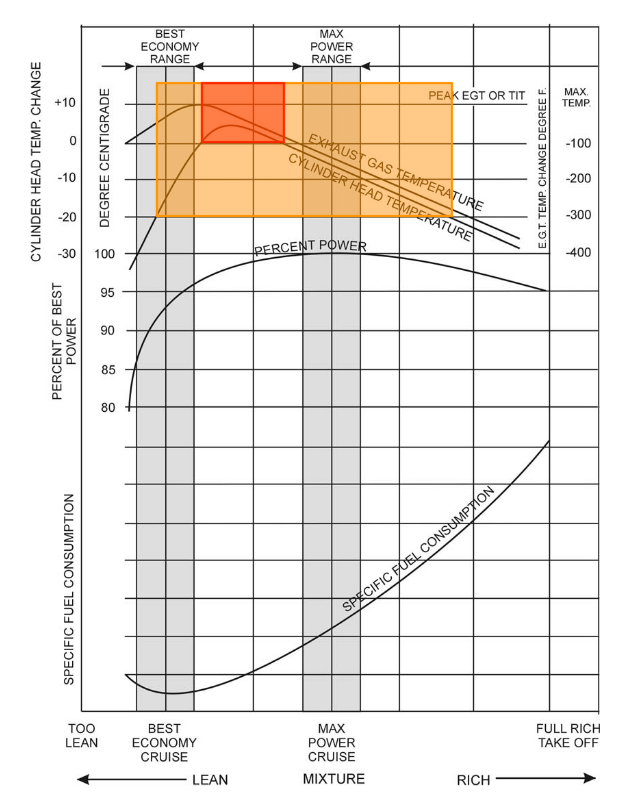
Using our personal CHT limits from earlier, we could think of the red area as representing operation above our personal maximum CHT and the orange area as representing the upper end of our preferred operating range. For a Lycoming engine, for example, that could mean 420°F as our personal maximum and 400°F as the upper end of our optimal range.
The important point is what we can do about it.
If the engine is operating in an undesirable region on the rich side of peak, we can move away from it in two directions: add considerably more fuel and operate further rich of peak, or reduce fuel flow and move through peak EGT to the lean side.
Provided the engine and installation can operate smoothly lean of peak, the second option allows us to reduce CHT and internal cylinder pressure while also reducing fuel consumption.
This is one of the reasons why understanding lean-of-peak operation is so useful. We are not simply leaning the engine because we want to save fuel. We are deliberately selecting a different combustion condition.
However, the Red Box is not fixed.
Its size depends on the power setting. At higher power, the range of mixture settings we want to avoid becomes wider. As power is reduced, the Red Box becomes progressively narrower until, at sufficiently low power, it effectively disappears. This is also why we can lean very aggressively during ground operations without worrying about operating on the “wrong” side of peak EGT.
This changing relationship between power and mixture is the basis for the more advanced Red Fin concept, which we discuss separately in our article on advanced leaning.
https://quest-aeronautics.com/advanced-leaning/
Advanced leaning therefore goes beyond simply finding peak EGT and selecting a number of degrees rich or lean of it. It means understanding how mixture, power, temperature, ignition, mixture distribution, and the individual engine installation interact, and then using the available engine data to make informed decisions.
It may also involve some due diligence on the aircraft itself. Uneven mixture distribution, induction leaks, ignition problems, or poorly balanced fuel injectors can limit how effectively an engine can be operated lean of peak. In suitable fuel-injected engines, calibrated injectors such as GAMIjectors may help improve mixture distribution and enable smoother lean-of-peak operation.
The important point is that advanced leaning is not necessarily complicated leaning. It is informed mixture management.
“But My Instructor / Mechanic Told Me…”
When pilot-owners receive advice about mixture management, it is worth considering the source and the context in which that advice was given. That includes advice from flight instructors, mechanics, other aircraft owners, engine manufacturers, online forums, and, of course, from us.
Different people within the aviation ecosystem look at the aircraft from different perspectives. A flight instructor may primarily be concerned with safe and simple operation. A mechanic may approach the subject from a maintenance and reliability perspective. The engine manufacturer has to provide procedures and limitations applicable across a broad range of aircraft installations and operating conditions. Another aircraft owner may simply be sharing what has worked well in a particular aircraft for many years.
None of these perspectives is necessarily wrong. But neither should they automatically be treated as universally applicable.
This becomes particularly important with mixture management because seemingly contradictory advice may have originated from different engines, installations, power settings, instrumentation, operating conditions, or objectives. “Always run rich of peak,” “never lean below 5,000 feet,” or “I have always operated it this way and never had a problem” may all make sense within a particular context. They are not, however, substitutes for understanding what is actually happening inside your own engine.
As pilot-owners, we therefore need to develop the ability to evaluate advice rather than simply follow it.
What engine and installation does the advice apply to? At what power setting? What temperatures are being observed? What instrumentation is available? What does the aircraft or engine manufacturer specify? And, perhaps most importantly, what is the underlying technical reasoning behind the recommendation?
This is part of taking responsibility for aircraft ownership. We can and should use the knowledge and experience available throughout the aviation ecosystem, but ultimately we need to understand enough to make informed decisions for our own aircraft.
Support can be delegated. Responsibility cannot.
Understanding Is More Important Than the Procedure
The red knob is not dangerous because pilots touch it. Poor mixture management comes from operating an engine without understanding the relationship between mixture, power, temperature, instrumentation, and engine limitations.
Modern engine instrumentation gives pilot-owners access to considerably more information than previous generations had available. We can monitor individual-cylinder EGTs and CHTs, fuel flow, TIT where applicable, and observe trends in real time.
But better instrumentation alone does not create better engine management.
Data only becomes useful when the pilot understands what decision that data is supposed to inform.
An EGT indication is useful because it helps us understand where we are relative to peak EGT. CHT helps us monitor the thermal condition of the cylinders. Fuel flow tells us something about what we are putting into the engine. Taken together, these parameters allow us to make more informed decisions about how we operate it.
This is why we strongly encourage pilot-owners to educate themselves about their particular engine and installation and develop their mixture-management skills beyond the simplified rules many of us initially learned during flight training.
You do not need to become an engine engineer or understand every detail of the combustion process. But if you own and operate a Continental- or Lycoming-powered aircraft with a conventional mixture control, you should understand enough to use that control deliberately.
Because ultimately, you are part of the engine-management system.
From Learning to Fly to Learning to Own
Mixture management is only one example of a broader challenge in general aviation.
Flight training teaches us how to operate an aircraft safely and competently. But owning an aircraft requires a broader set of skills and a different level of understanding.
As pilot-owners, we make decisions about maintenance, engine operation, upgrades, reliability, operating costs, and how the aircraft is used over many years. Many of these decisions are not covered in any meaningful depth during conventional flight training.
Mixture management illustrates this gap particularly well. A pilot may know when to move the red knob without necessarily understanding what the mixture control is actually doing, how to interpret the available engine data, or how different operating decisions may affect the engine over time.
The same pattern appears throughout aircraft ownership.
This is why we created the Aircraft Ownership Workshop.
The workshop is designed to help prospective and early-stage pilot-owners develop a more structured understanding of aircraft ownership and make better-informed decisions about the aircraft they fly, maintain, and ultimately take responsibility for.
It is not about turning pilot-owners into mechanics, engineers, or aviation experts. It is about understanding enough to ask better questions, evaluate the advice you receive, and make informed decisions about your own aircraft.
Because learning to fly an aircraft and learning to own one are not the same thing.
Frequently Asked Questions
Aircraft engine leaning is the process of adjusting fuel flow relative to the available air to achieve an appropriate fuel-air mixture. In conventional Continental- and Lycoming-powered aircraft, pilots use the mixture control to manage combustion, power, fuel consumption and engine temperatures.
Rich of peak (ROP) means operating with a mixture richer than the point of peak exhaust gas temperature (EGT). Lean of peak (LOP) means operating with a mixture leaner than peak EGT. The appropriate operating range depends on the engine, installation, power setting and applicable limitations.
EGT provides a reference for identifying peak EGT and adjusting the mixture. Cylinder head temperature (CHT) helps pilots monitor the thermal condition of the cylinders. Both should be interpreted in the context of the applicable aircraft and engine operating instructions.
No. Lean-of-peak operation depends on the engine design, fuel-air distribution, instrumentation, power setting and manufacturer limitations. Some engines can operate smoothly lean of peak, while others may experience roughness or may not be approved for the intended operating conditions.
Not necessarily. The appropriate mixture depends on factors such as air density, power setting, engine installation and operating phase. Pilots should follow the applicable POH/AFM and engine operating manual rather than rely on a single altitude-based rule.
Aviation Workshop
About Quest Aeronautics
Quest Aeronautics is a state-certified engineering office for aviation, dedicated to shaping the future of general aviation by providing innovative and cost-effective solutions to enhance aircraft performance and operations. With a focus on CS/FAR-23 and experimental/amateur-built (E/A-B) aircraft, Quest Aeronautics provides a range of services including flight testing, aircraft operations and maintenance consulting, high-quality aviation products, and tailored support for E/A-B projects. Collaborating with industry-leading partners, Quest Aeronautics is committed to delivering unparalleled support and expertise to individuals and organisations in the general aviation market.
About Author
Sebastian, the founder of Quest Aeronautics, is a driven and enthusiastic individual with a passion for aviation. Before delving into aviation, he gained valuable experience as a chemical process engineer and laboratory technician. Sebastian holds a Master of Science in Engineering and a commercial pilot licence, with several fixed-wing aircraft ratings under his belt. He has also completed an introduction course for fixed-wing performance and flying qualities flight testing at the National Test Pilot School in Mojave, CA and is compliance verification engineer for flight.