
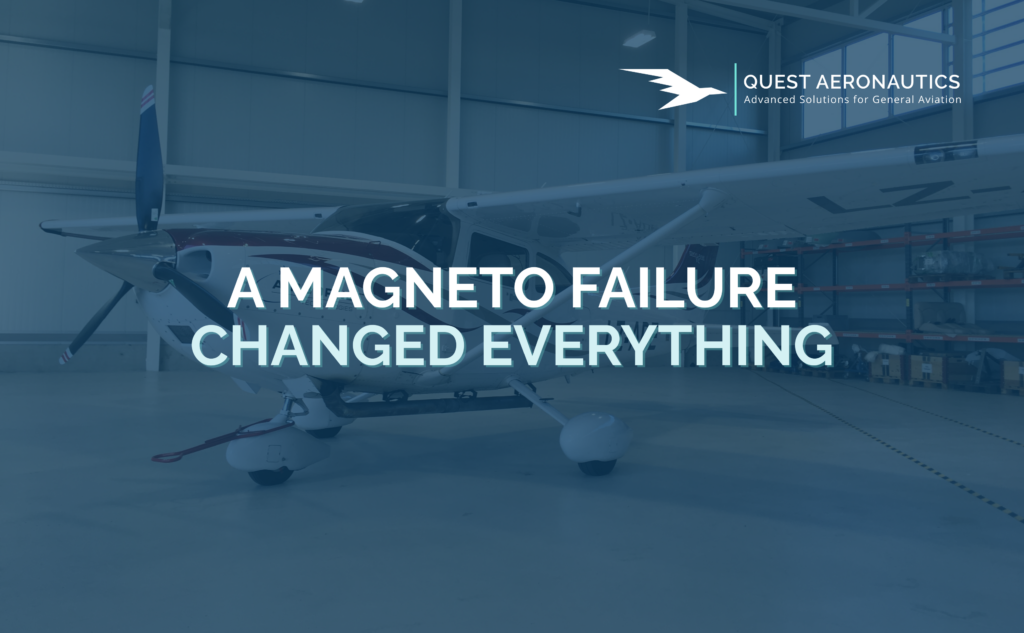
A magneto failure on our Cessna T182T Turbo Skylane ended my very first assignment as a survey pilot and forced us to take an airliner back home. Things certainly did not go as planned, but looking back, I learned quite a lot from that short adventure. Before we talk about the failure and the lessons I learned flying the Cessna T182T Turbo Skylane, let me explain how I ended up there in the first place.
When I was about to finish my master’s degree, I was fortunate enough to be offered a permanent position as a flight test engineer at an Austrian aerospace and special-mission engineering company. I had written my master’s thesis during an internship at the company and gained some exposure to the actual work of a flight test engineer. To my surprise, I also had the opportunity to gain some hands-on experience as a survey pilot.
Shortly before the internship ended, and just before I was due to head to California to attend the Introduction to Fixed Wing Performance and Handling Qualities Flight Testing Short Course at the National Test Pilot School, I was asked to fly a survey assignment in Northern Germany with a Cessna T182T Turbo Skylane.
The assignment was reasonably simple. Fly the aircraft to the on-site location, complete the remaining survey lines over the Wadden Sea, and return home within a week. Unfortunately, at that time, I had practically no experience flying the Cessna T182T Turbo Skylane or conducting survey flights. We therefore had relatively little time to bring me up to speed on both fronts.
It was not ideal that I had little experience beyond what was required for my commercial pilot licence and instrument rating, especially considering that the operational area was approximately 500 nautical miles away from our home base. There was another assignment closer to home, but the aircraft allocated to that job was a twin-engine aircraft, which I ended up flying quite a bit later. The more conservative decision was therefore made to stick with the single-engine Cessna and send me to Northern Germany. At least, that was the thinking at the time.
Prefer to watch instead of read?
Being Qualified and Being Prepared Are Not Necessarily the Same Thing
I received a checkout on the Cessna T182T Turbo Skylane and practised some survey-flying techniques before the assignment. In retrospect, I probably did not have enough experience on type or with the specific mission to accomplish the job as effectively as I should have. Nevertheless, we moved ahead.
Just to be clear, I was legally qualified to fly the Cessna T182T Turbo Skylane and had completed the necessary aircraft difference training. I also had the commercial pilot licence and instrument rating required for the operations we intended to conduct. But there is a considerable difference between being qualified to operate an aircraft and being genuinely proficient in a particular aircraft, mission, and operational environment.
Survey flying, especially laser scanning and aerial photography, is a rather different kind of flying from what most pilots are accustomed to. You can imagine it as flying an ILS approach for an extended period, except that you are following a predefined survey line instead of an instrument approach. Depending on the equipment and mission requirements, you may need to maintain very precise lateral and vertical positioning, as well as a particular groundspeed. You cannot necessarily use the normal aileron corrections you would use during conventional flying because excessive aircraft attitude changes can interfere with the measuring equipment. Instead, corrections may need to be made while keeping the wings as level as possible, using the rudder to maintain alignment with the survey line.
At the same time, you need to control your vertical position, often through power adjustments, and stay within the permitted speed range. Depending on the geographical area and weather, this can become quite challenging. Wind, terrain, obstacles, clouds, and the limitations of the aircraft and surveying equipment all need to be considered.
It is not unusual to use considerably different power settings and aircraft configurations depending on the direction of the survey line. A strong headwind in one direction and a tailwind in the other can require substantial adjustments to maintain the desired groundspeed. In some operations, you may also need to change altitude along the line to accommodate terrain or obstacles.
You get the idea. Although the individual flying techniques are not necessarily complicated, combining them while maintaining the required precision takes practice. With that in mind, we headed off to Northern Germany.
The ferry flight itself was reasonably uneventful, although I would not say I felt particularly confident. I was still getting accustomed to the aircraft, and operating away introduced several additional challenges. We made a fuel stop along the way and eventually arrived at our destination, where an unstable approach resulted in a go-around before we landed safely.
We parked the aircraft in the hangar, called it a day, and headed to the hotel.
Our First Survey Day Did Not Go Particularly Well
Surveying the Wadden Sea introduced an additional constraint I had not encountered before. Because of the tides, we had only a relatively short period each day during which the area could be surveyed under the required conditions. We therefore had to coordinate our flying with the available tidal window.
Unfortunately, on the first day, I had not allocated enough time to power up and warm up the survey equipment. As a result, we arrived in the operational area later than planned.
To make matters worse, I followed the advice of a fellow pilot and initially tried to fly the survey lines using the autopilot. That turned out to be a poor choice. The autopilot was not particularly suitable for maintaining the precision and flight conditions required for this mission, and our attempts to use it were largely unsuccessful.
Eventually, I switched to hand flying and managed to complete a few lines before our available time ran out. We returned to the airfield having accomplished considerably less than planned. It was frustrating, but at least we had learned something. We needed to start earlier, allow more time for the equipment, and rely on manual flying for the survey lines.
The following morning, we adjusted our preparations accordingly. Unfortunately, the aircraft had other plans.
The Magneto Failure That Ended the Assignment
The second day was noticeably colder, which meant that the survey equipment, particularly the laser scanner, needed even more time to reach its operating temperature.
Fortunately, we had planned for that. We started the preparations earlier and waited on the ramp with the aircraft engine running while the equipment warmed up.
At that time, I had very little understanding of how to operate a Lycoming engine efficiently, particularly with regard to ground leaning and engine management. I was running the engine at a relatively low power setting without leaning the mixture as aggressively as I would today.
Eventually, the equipment operator gave me the thumbs up, indicating that everything was ready. I taxied to the holding point and continued with the before-take-off checks.
When I reached the magneto check and selected one magneto, the engine almost quit on us.
I immediately selected both magnetos again, and the engine continued running. Initially, I suspected something relatively simple, perhaps fouled spark plugs. I increased the engine power for a while and repeated the magneto check, hoping that the problem would disappear.
It did not.
Again, the engine would have quit had I kept it running on that magneto, suggesting that something was seriously wrong with the ignition system.
There was no question of departing under those circumstances. We taxied back, shut the engine down, scratched our heads, and arranged for a mechanic from another airfield to investigate the problem.
Because I was relatively inexperienced, I did not remove the engine cowling to look for obvious problems myself. Instead, I waited for the mechanic.
As it turned out, the mechanic diagnosed a failed magneto rather than a simple problem such as fouled spark plugs or an obvious external ignition-system defect. A replacement had to be ordered, and the aircraft was grounded.
Since I was due to leave for California shortly afterwards, there was no realistic opportunity for me to finish the assignment. We therefore returned home by airline, leaving the Cessna in Northern Germany until it could be repaired. That was the rather disappointing end of my first assignment as a survey pilot.
I did get to fly the Cessna T182T Turbo Skylane again later, before it was eventually sold. I also received training on the Tecnam P2006T for survey missions and flew the Vulcanair P68R for demonstration flights. But this first assignment stayed with me, mainly because it exposed several gaps in my experience and understanding that I would only fully appreciate much later.
What I Would Do Differently Today
In retrospect, many things could have been done better, from aircraft and engine management to flight operations, mission preparation, and troubleshooting. But I want to highlight a few things that immediately came to mind when I recall this assignment.
The first is the difference between having the qualifications to fly an aircraft and having the experience to operate it confidently in an unfamiliar environment.
As I mentioned earlier, I was legally qualified and had the necessary foundation to fly the Cessna T182T Turbo Skylane. Nevertheless, I probably should have spent more time becoming familiar with the aircraft and practising the specific survey techniques before heading off to Northern Germany.
More practice flying survey lines, intercepting them accurately, maintaining the required speed and altitude, and communicating with the equipment operator would have reduced my workload considerably. It would also have helped me understand the limitations of the aircraft and survey equipment before trying to complete an actual mission under time pressure.
Another consideration was the location. Operating and troubleshooting an aircraft several hundred nautical miles away from its home base is inherently more complicated than dealing with the same problem locally. If the assignment had been closer to home, organising maintenance, coordinating people, and recovering the aircraft would probably have been easier and less expensive.
Of course, I do not think that choosing a different location would have prevented the magneto failure. The failure would have happened anyway. But it would have changed the consequences and how easily we could respond to the situation.
This is something I only gradually came to appreciate: being able to fly an aircraft is one thing. Being able to operate it effectively within a particular mission, while understanding the surrounding operational constraints, is another.
Experience, Exposure, and Confidence
To be honest, the trip itself was challenging for me because there were so many aspects of flying I had not yet been exposed to sufficiently.
When you have only recently obtained your commercial pilot licence and instrument rating, you may understand the procedures and have demonstrated the required proficiency during training and examinations. But that does not mean you have experienced every situation you might encounter during actual operations.
IFR pickups, transitions between IFR and VFR, unfamiliar ATC procedures, frequency and transponder squawk changes during longer cross-country flights, different weather conditions, local weather phenomena, crosswind take-offs and landings, short-field operations, and many other situations all become easier to manage as you gain experience.
Individually, these are ordinary aspects of flying. However, when several unfamiliar elements come together, the workload can increase significantly.
You are not necessarily doing anything particularly difficult, but you are constantly thinking about things that a more experienced pilot might handle almost automatically. That leaves less mental capacity for unexpected problems, changes in plans, or decisions that require more attention.
I believe that is one of the reasons why experience is so valuable. It is not simply about accumulating flying hours. It is about being exposed to different situations, learning how to manage them, and gradually developing a better understanding of your own abilities and limitations.
The experience required to feel comfortable is different for everyone. Personally, it took me several hundred flying hours and many sorties as a flight test engineer before I began to feel genuinely comfortable with my ability to handle unfamiliar situations and make decisions under pressure.
That does not mean I stopped being excited about flying or encountering new challenges. Quite the opposite. I still enjoy learning, improving my skills, and expanding my capabilities.
But the nature of the challenge changes as you gain experience. Things that initially require considerable attention eventually become familiar, allowing you to concentrate on more demanding aspects of the operation.
This is also why I encourage pilots to fly regularly and gain exposure to different conditions, aircraft operations, and environments, always within their capabilities and with appropriate preparation.
If you fly the same route, in the same aircraft, under the same favourable weather conditions every time, you may accumulate a considerable number of hours without developing much experience outside those familiar circumstances.
There is nothing wrong with that if those are the only operations you intend to conduct. But if you want to become proficient in a wider range of situations, you need to expose yourself to them gradually, ideally with experienced support when appropriate.
Competence and confidence develop through practice, but the quality and variety of that practice matter.
Understanding Your Aircraft and Its Systems
Another important lesson concerned the operation of the aircraft itself, particularly the autopilot and engine.
Our attempt to use the autopilot for the survey lines was not particularly successful. The system was not designed to deal with the precision and constraints we required in that particular situation, and trying to use it initially made things more complicated rather than easier.
That does not mean autopilots are generally unsuitable or should be avoided. Quite the opposite.
A properly operated autopilot can be an extremely useful tool, particularly during challenging instrument flying, high-workload situations, or approaches in marginal weather. It can reduce workload, improve situational awareness, and allow the pilot to devote more attention to communication, navigation, weather, and decision-making.
However, that is only true when the pilot understands how the system works, what it can and cannot do, and how to monitor it correctly.
An autopilot that is used incorrectly can create additional problems and potentially dangerous situations. For example, selecting a particular vertical-speed mode during a climb without adequately monitoring airspeed and aircraft performance can lead to an unintended reduction in airspeed as the available climb performance decreases. But that is probably a topic for another article.
The important point is that you should become familiar and proficient with the aircraft’s avionics and autopilot before you need them in demanding conditions. You should also remain proficient at flying manually, because automation may be unsuitable for a particular task or unavailable when you need it.
I do not want to find myself hand flying an approach in challenging weather simply because I had never properly learned how to operate the autopilot. At the same time, I do not want to become dependent on the autopilot to the point where I was uncomfortable flying without it.
The same applies to the engine. At the time of the magneto failure, I knew enough to operate the aircraft according to the procedures I had been taught. However, my understanding of engine management, ignition systems, leaning techniques, and troubleshooting was still relatively limited.
Today, I would approach the problem differently. I would first try to understand the symptoms and isolate the problem as systematically as possible, within the limitations of my knowledge, the aircraft procedures, and the applicable maintenance requirements. Rather than simply reporting that the magneto check had failed, I would want to provide the mechanic with useful observations about the engine’s behaviour and the circumstances under which the problem occurred.
Where appropriate and permitted, I would also consider inspecting accessible components for obvious defects, or work with the mechanic to understand what should be checked and why. I am not convinced that the entire magneto necessarily needed to be replaced. An inspection and repair as necessary (IRAN) might have been sufficient. That said, I am not sure if that would have expedited the process, but it could have lowered the costs.
Just to be clear, I do not try to replace a qualified mechanic or perform maintenance beyond my competence or authorisation, but I try to understand the problem well enough to communicate clearly, evaluate the findings, and participate intelligently in the decision-making process.
After the magneto failure, a fellow pilot suggested that I might have caused the problem by overheating the magneto. His explanation was that the magnetos on this turbocharged engine were connected to the turbocharger for cooling, and that my engine operation on the ground had somehow caused the failure.
I was interested in understanding whether that explanation was correct. To be honest, I was not entirely convinced and did not trust the pilot, so I started researching the system myself.
What I learned was that the connection between the turbocharging system and the magnetos served a different purpose. On certain high-altitude ignition installations, magnetos are pressurised to maintain sufficient dielectric strength inside the magneto as ambient air pressure decreases.
At higher altitudes, the reduced air density can make unintended electrical discharge more likely. Pressurisation helps maintain the insulation required for reliable ignition-system operation.
In other words, the system was not intended to cool the magnetos as my fellow pilot had suggested. Its purpose is to maintain sufficient electrical insulation inside the magnetos at altitude, allowing the ignition system to operate reliably.
That did not establish why our magneto failed, but it helped me understand why the explanation I had been given was questionable. And this is something I consider important today, not only in aviation.
There is considerable value in listening to experienced people, mechanics, instructors, engineers, and fellow pilots. But experience or confidence alone does not make every explanation correct.
When something does not make sense, it is worth asking questions, investigating the underlying principles, and trying to understand the actual mechanism rather than simply accepting the first explanation that sounds plausible.
We do not need to question everyone for the sake of questioning them. But we should develop enough understanding to distinguish between sound reasoning, assumptions, and opinions.
One final lesson from the magneto incident concerns checklist discipline.
The failure was identified during the before-take-off check, before we departed. Whatever the precise cause of the problem, the check did what it was supposed to do.
It is tempting to rush procedures when the weather is uncomfortable, other aircraft are waiting, passengers are impatient, or an operational window is closing. Sometimes you may even feel that repeating familiar checks is unnecessary. But there is a reason those procedures exist.
I would much rather delay a departure or let another aircraft go ahead than rush through an important check because I feel under pressure.
Developing Judgement Without Exceeding Your Limits
All of this leads to perhaps the most important lesson I have taken from my early flying experience.
If you want to become a more competent pilot, you need to challenge yourself and gain exposure to unfamiliar situations. At the same time, you must be careful not to confuse expanding your experience with exceeding your capabilities.
There is a difference between operating outside your comfort zone and operating outside your limits.
Your comfort zone is influenced by familiarity, confidence, and previous exposure. Your actual operational limits depend on your competence, the aircraft, the environment, the available margins, and the risks involved.
Those limits are not necessarily the same.
Something can feel uncomfortable because it is unfamiliar, even though you are adequately prepared and the operation is well within your capabilities. Conversely, something may feel entirely comfortable because you have done it many times, even though the risks are greater than you realise.
That is why I think pilots should deliberately expand their experience, but do so in a controlled and systematic way.
Take your time, prepare properly, and seek additional training or experienced support when necessary. Do not worry excessively about making conservative decisions. There is no prize for taking unnecessary risks, and being the pilot in command means accepting responsibility for the decisions you make.
Personally, I tend to make conservative decisions, and one decision-making framework I find useful is the three-strike approach that I learned from Mike Patey.
The underlying idea is relatively simple. Individual deviations from ideal conditions may be manageable, but several occurring together can significantly increase the risk of an operation.
An inoperative instrument that would otherwise be permissible, marginal weather, night operations, fatigue, unfamiliar terrain, or limited recent experience might each represent an additional concern.
If three of these factors accumulate, the sensible decision may be to cancel or postpone the flight rather than continue.
I find this useful because risks rarely exist in isolation. The same weather conditions that are manageable when you are rested, current, and familiar with the aircraft may be considerably more demanding when you are tired, operating somewhere unfamiliar, or dealing with equipment problems.
Of course, such a personal rule is not a substitute for proper risk assessment, and a single serious issue may be sufficient reason not to fly at all. But it can help remind you to consider the combined effect of several seemingly manageable factors.
There is another aspect of conservative decision-making that I have struggled with myself.
In the past, I have decided to remain on the ground and cancel flights because I was not comfortable with the forecast weather or other circumstances. Sometimes, the following day, I discovered that the weather had actually been better than expected and that the flight might have been possible after all.
I occasionally find myself questioning those decisions, thinking that I could have completed the flight if only I had been a little less conservative. But that is not a particularly useful way to evaluate the decision.
When I made the decision, I did not have the information that became available afterwards. I had a forecast, an understanding of my own capabilities, the aircraft’s limitations, and whatever other information was available at that time.
The fact that the flight might have been possible in hindsight does not automatically mean that cancelling it was the wrong decision.
This is important because we tend to judge decisions based on their outcomes. If everything works out, we assume the decision was good. If something goes wrong, we assume it was bad. But that is not necessarily true.
A poor decision can have a favourable outcome, just as a well-considered decision can sometimes produce an unfavourable one. What matters is whether the decision was reasonable given the information, uncertainty, and risks known at the time.
This is something I still remind myself of, and it applies well beyond aviation.
You should always be willing to review your decisions and learn from new information. But there is little value in beating yourself up simply because hindsight makes an alternative decision look more attractive.
What Stayed With Me
Looking back at my first survey assignment in the Cessna T182T Turbo Skylane, I can identify quite a few things I would do differently today.
I would spend more time familiarising myself with the aircraft and mission before departure. I would prepare more carefully for the operational constraints, use the available technology more appropriately, and approach technical problems with a better understanding of the systems involved.
I would also pay more attention to how several unfamiliar elements can accumulate and increase workload, even when none of them is particularly challenging on its own. But I do not believe that being more experienced would necessarily have prevented the magneto failure or guaranteed that the assignment would have been completed successfully.
Aircraft develop technical problems. Weather changes. Equipment does not always work as expected. Plans fall apart, sometimes for reasons largely outside our control.
What changes with experience is our ability to recognise problems, understand their implications, evaluate possible responses, and make decisions without becoming unnecessarily overwhelmed by uncertainty.
That was certainly true for me. It took many more flights, different aircraft, unfamiliar operating environments, and plenty of additional challenges before I began to feel comfortable with my own abilities and limitations. And even today, there are situations where I have to recognise that I need more preparation, more information, or simply a different plan.
I do not think that ever really stops. Genuine confidence comes from competence, and the two are usually closely connected, but they are not quite the same thing. Confidence without sufficient competence can become dangerous, while competence without confidence can prevent us from making effective use of the capabilities we have developed.
The objective, in my view, is to keep developing both through deliberate experience, continued learning, and honest reflection.
My first survey assignment was short, and it certainly did not go as planned. But it gave me plenty to think about, and some of those lessons have stayed with me throughout my career.
Perhaps that is ultimately what makes experiences like this valuable. Not everything has to go according to plan for us to learn something useful.
Continue the Conversation
If you are a prospective or early-stage aircraft owner and would like to develop a better understanding of aircraft ownership, engine operation, maintenance, and evidence-based decision-making, we regularly host Aircraft Ownership Workshops at Quest Aeronautics.
We explore practical topics that can help you become a more informed, capable, and independent pilot-owner, make better decisions, and approach aircraft ownership with greater confidence.
You can find more information about our upcoming workshops below.
Frequently Asked Questions
Being a qualified pilot means holding the required licences, ratings, and training for an operation. Proficiency goes further. It involves having the practical experience, aircraft knowledge, and operational skills to manage the specific aircraft, mission, and environment confidently.
Experience helps pilots recognise situations, manage workload, understand operational limitations, and make better decisions under pressure. It is not simply about accumulating flight hours, but about gaining exposure to different conditions and learning from them.
A magneto failure can result from problems within the ignition system. In the Cessna T182T Turbo Skylane described in this article, the mechanic diagnosed a failed magneto. The precise underlying cause was not established.
Understanding aircraft systems helps pilots use equipment correctly, recognise limitations, identify potential problems, and communicate more effectively with maintenance professionals. This is particularly important when operating in unfamiliar or demanding conditions.
Autopilots can reduce workload and support situational awareness, but they are not suitable for every task or situation. Pilots should understand their functionality and limitations while maintaining the ability to fly manually if automation becomes unsuitable or unavailable.
Pilots can improve decision-making through deliberate practice, exposure to different operating environments, proper preparation, and honest evaluation of previous decisions. They should also recognise their personal limitations and consider how multiple risk factors can accumulate.
Aviation Workshop
About Quest Aeronautics
Quest Aeronautics is a state-certified engineering office for aviation, dedicated to shaping the future of general aviation by providing innovative and cost-effective solutions to enhance aircraft performance and operations. With a focus on CS/FAR-23 and experimental/amateur-built (E/A-B) aircraft, Quest Aeronautics provides a range of services including flight testing, aircraft operations and maintenance consulting, high-quality aviation products, and tailored support for E/A-B projects. Collaborating with industry-leading partners, Quest Aeronautics is committed to delivering unparalleled support and expertise to individuals and organisations in the general aviation market.
About Author
Sebastian, the founder of Quest Aeronautics, is a driven and enthusiastic individual with a passion for aviation. Before delving into aviation, he gained valuable experience as a chemical process engineer and laboratory technician. Sebastian holds a Master of Science in Engineering and a commercial pilot licence, with several fixed-wing aircraft ratings under his belt. He has also completed an introduction course for fixed-wing performance and flying qualities flight testing at the National Test Pilot School in Mojave, CA and is compliance verification engineer for flight.