
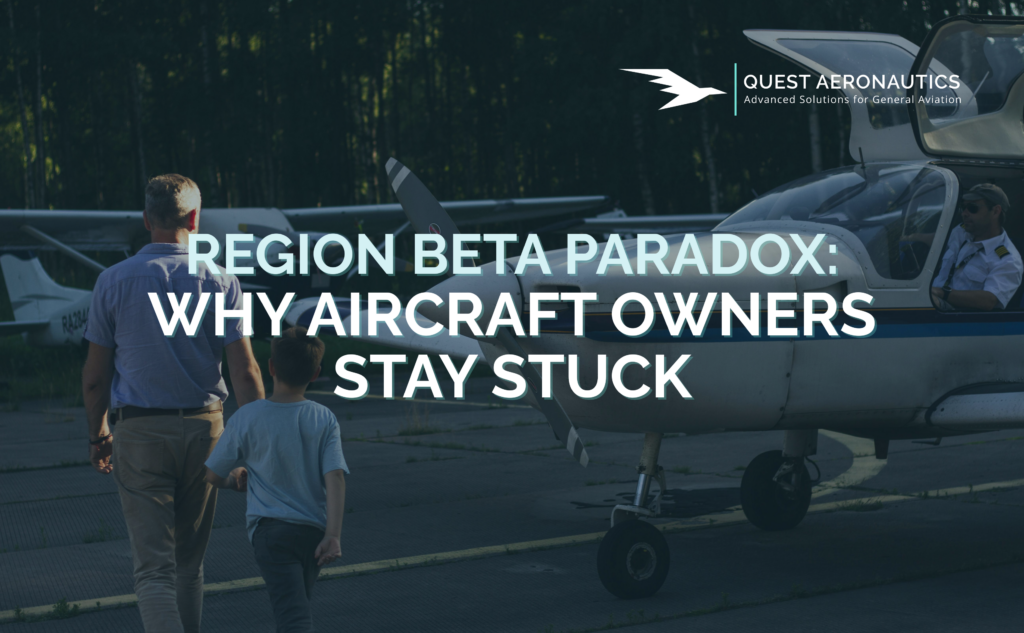
Worse Situations Now Can Lead to Better Situations Later
Two years ago, I was sitting on the couch in my apartment watching an episode of Modern Wisdom, hosted by Chris Williamson, featuring Alex Hormozi: Be Ruthless About the Life You Want – Alex Hormozi (4K)
You may be familiar with both Chris and Alex. Chris is a former nightclub promoter and Love Island contestant turned podcaster and, you could probably say, modern philosopher. Alex is a former gym owner, still always jacked, self-made entrepreneur, investor, and author. His latest book, $100M Money Models, even set the Guinness World Record for the fastest-selling non-fiction book.
One framework has stuck with me ever since: the Region Beta Paradox. Occasionally, I find myself thinking about it, especially when I encounter a situation where it might apply.
Please note, the Region Beta Paradox should not be confused with the Beta Range and/or Reverse Pitch/Thrust.
Region Beta Paradox
For those unfamiliar with it, the Region Beta Paradox explains why someone can sometimes be better off if a particular situation were worse.
Let me explain using some of the examples Chris gave.
Imagine you have to travel a mile or less. You might walk. If you have to travel more than a mile, you might drive. Paradoxically, you could therefore travel two miles faster than one mile.
The important insight is that a subjectively worse situation can sometimes lead to a better outcome because it pushes you beyond the threshold required to take action.
For example, let’s assume you are in a mediocre relationship. You are not really in love with your partner and your goals are not particularly aligned, but you have been together for three years and moved in together. Breaking up would mean finding a new partner and probably a new apartment.
Or let’s say your current job is not very fulfilling. Your supervisor is a bit of a dickhead and the company’s values and goals are not aligned with yours, but the pay is not too bad and the office is around the corner from your apartment.
Neither situation is particularly good. But neither is quite bad enough to force you to change it.
The pain has to exceed a certain threshold before you take action to change the situation.
The concept stayed in the back of my mind. Much later, while working through the Aviation Ecosystem and the Three Critical Mistakes of Aircraft Ownership, I realised that the same paradox applies to aircraft ownership.
Prefer to watch instead of read?
Aircraft Ownership and the Region Beta Paradox
Most pilot-owners may not be familiar with the Region Beta Paradox, but many know its consequences.
They may feel uncertain about the decisions they make and the condition of their aircraft. They may experience a lack of control, support, and trust, while worrying about reliability and safety. At the same time, many pilot-owners spend years figuring out a better way to approach aircraft ownership through trial and error, if they ever do.
Along the way, they may waste money and resources, lose time, experience reliability problems, and expose themselves to unnecessary risk. Some recognise these problems quite clearly. Others gradually become accustomed to them because they appear to be part of normal aircraft ownership.
Aircraft ownership can remain bad enough to frustrate the owner, but not bad enough to force meaningful change.
Another maintenance bill is painful, but affordable. Another cancelled trip gets accepted as “aviation.” Advice from different stakeholders conflicts, but there is always someone else to ask. Reliability is inconsistent, but not disastrous. Operating habits may be inefficient, but the aircraft still flies. Recurring maintenance problems get solved individually. Over time, the owner may even begin flying less or planning less ambitious trips.
Each event is tolerable. Collectively, however, they can seriously degrade the ownership experience.
Many pilot-owners eventually accept the situation and tell themselves that this is simply what aircraft ownership is supposed to be because it has always been that way. That belief is often reinforced by fellow pilots, aircraft owners, flying clubs, and maintenance organisations.
For some owners, the situation eventually becomes difficult enough that they make a fundamental change. For others, the accumulated uncertainty, cost, reliability problems, and frustration may become unbearable enough that they sell the aircraft altogether, giving up part of the freedom, purpose, and meaningful experiences they originally wanted aircraft ownership to create.
Why Pilot-Owners Stay in Region Beta
Many pilots and aircraft owners do not change their approach because aircraft ownership remains tolerable, even if only barely. The aircraft still flies. The bills are painful but still affordable, even if they are sometimes difficult to justify. The advice is fragmented and inconsistent, but available. Reliability is imperfect, but not disastrous.
Nothing is quite bad enough to force a fundamental rethink.
So the pilot-owner remains inside an ownership system that produces mediocre results. Part of the reason, although not necessarily the root cause, is the aviation ecosystem.
The Aviation Ecosystem
The aviation ecosystem does many things well, but it is not designed to make sure you get the most out of aircraft ownership. It is generally good at solving individual problems.
A mechanic solves the squawk. An instructor answers the flying question. A flight school helps you obtain your licence. A CAMO or CAO manages compliance. A broker or dealer supports the acquisition. Fellow pilots provide advice.
This support is valuable. But no single stakeholder is responsible for optimising the full ownership journey from the pilot-owner’s perspective.
That matters because the ecosystem can be good enough at solving individual problems that the pilot-owner never has to confront the weakness of the overall ownership system. The immediate problem gets fixed, so the underlying ownership model never has to change.
What is often missing is something like a general contractor or, perhaps more fittingly, a conductor who leads the complete aircraft ownership orchestra.
Unfortunately, without that conductor, many pilot-owners fall into the same three costly mistakes.
The Three Critical Mistakes
Working in general aviation, including as a pilot and Head of Flight Operations, taught me some lessons that are difficult to learn from theory alone. But when I started working specifically in the aircraft ownership space, I began to notice three recurring mistakes that pilot-owners make.
They are subtle because they are reinforced by the way general aviation and aircraft ownership normally work. But once you notice them, they are difficult to unsee.
The first is outsourcing ownership thinking to the aviation ecosystem.
This often starts before ownership itself. Someone becomes interested in general aviation, joins a local flying club, and speaks with pilots and aircraft owners around them. Those people naturally introduce them to the established path: flight schools, instructors, maintenance organisations, CAMOs, manufacturers, brokers, and the way things have traditionally been done.
There is nothing inherently wrong with that. The problem begins when the established path becomes the ownership strategy.
Decisions then start being made through individual opinions and isolated events rather than within a bigger picture. As I mentioned earlier, the aviation ecosystem is designed to support aircraft ownership, but it is not designed to optimise it from the pilot-owner’s perspective.
The second mistake is making decisions without a reliable framework.
When aircraft ownership is treated as a sequence of isolated events, decisions are made in isolation too. What happened in the past, what is happening now, and what the decision means for the future are not always connected. Decisions become ad hoc rather than systematic.
We have a saying at Quest Aeronautics: aircraft ownership without engine intelligence is guesswork.
And we mean it.
Aircraft ownership and operation are not a sequence of unrelated events. They form a coherent, interrelated system. Only when you have a reliable setup and decision framework can you make decisions based on knowledge, data, evidence, and context rather than assumptions or whoever happens to have the strongest opinion at the time.
The third mistake is operating reactively instead of like a professional operator.
Flight operation is obviously an important part of aircraft ownership. But professional operation is not only about how you fly the aircraft, your stick-and-rudder skills, or how you manage the engine in flight. It also includes how you treat the aircraft before, during, and after every flight.
If pilot-owners preheat or cool down the engine only when they feel like it, ignore preservation when the aircraft sits, or avoid proper leaning because they have never developed a disciplined operating philosophy, they cannot reasonably expect the best possible reliability, efficiency, and ownership experience.
These three mistakes reinforce each other.
The owner relies heavily on the aviation ecosystem, makes decisions without a reliable framework, and reacts to individual events rather than governing aircraft ownership as one coherent system.
Aircraft owners can remain in that mediocre ownership system for years because the individual problems remain tolerable and the aviation ecosystem is capable of solving them one at a time. The immediate problem gets fixed, so the underlying ownership model never has to change.
That is the Region Beta Paradox of aircraft ownership.
Do Not Wait for Aircraft Ownership to Become Unbearable
Aircraft ownership is meant to be a source of freedom, purpose, and meaningful experiences. And, to be fair, it can be exactly that.
But the likelihood of achieving that increases significantly when we do not remain in Region Beta and instead take control of the aircraft ownership journey.
You do not have to wait for another huge maintenance invoice, a serious reliability issue, repeated cancelled trips, complete loss of confidence, or the moment ownership finally becomes unbearable. You can start changing the way you approach aircraft ownership before any of that happens.
At Quest Aeronautics, we have coined three principles to describe that shift: think independently, decide systematically, and execute professionally.
They are not complicated ideas. They are simply a way of describing the move from reactive aircraft ownership toward a more structured and deliberate approach.
Think Independently
One thing you can do immediately is become more knowledgeable about aircraft ownership, its stakeholders, and the systems around your aircraft.
Understand the roles, incentives, responsibilities, and limitations of the people and organisations you rely on. Learn why certain things are done the way they are, what assumptions sit behind them, and whether a different approach may be more appropriate for your aircraft, mission, and ownership goals.
In short, challenge the status quo where necessary and think independently.
That does not mean rejecting expert advice. It means understanding it well enough to evaluate it.
Decide Systematically
Once you understand the system better, the next step is to improve how decisions are made.
That may include better use of engine condition monitoring, clearer rules with your maintenance organisation or mechanic, defined approval thresholds, and a more structured way to evaluate findings and recommendations.
Where components can be monitored reliably and the regulatory and technical context allows it, condition-based decisions may also become part of that framework.
The important point is not one specific maintenance strategy.
It is that decisions should no longer be made ad hoc, based purely on habit, urgency, or whoever happens to be giving advice at the time. They should be made using knowledge, data, evidence, and clearly understood criteria.
Execute Professionally
Knowledge and better decisions only matter if they translate into consistent action.
Professional operation means understanding what matters and then treating the aircraft accordingly, with discipline and prudence.
That includes how the aircraft is operated in flight, but also how it is treated before and after flight, how maintenance is prepared and governed, how data is reviewed, and how recurring issues are handled over time.
The goal is not perfection. It is consistency.
A structured ownership approach gives you a much better chance of making the aircraft more reliable, more predictable, and more aligned with what you wanted ownership to provide in the first place.
Structured Aircraft Ownership Does Not Mean Doing Everything Yourself
You do not need to become an aircraft mechanic or do everything by yourself. The goal is to develop enough knowledge, understanding, and practical judgement to make informed decisions and participate intelligently in the ownership process.
You will also never remove all uncertainty or reliability risk from aircraft ownership. Parts fail, maintenance findings surprise you, and flights occasionally get cancelled. That is part of operating general aviation aircraft.
But there is a difference between accepting uncertainty and operating without structure.
Structured aircraft ownership puts you in a better position to ask better questions, evaluate recommendations, understand the evidence behind a decision, and recognise what applies to your aircraft and mission.
It is similar to running a business or any other high-stakes undertaking. You do not need to perform every specialist task yourself, but you do need enough understanding to participate in the decisions that matter.
Good judgement can be supported by specialists. Ownership responsibility cannot simply be outsourced.
Aircraft Ownership Will Always Involve Uncertainty
A structured ownership approach does not eliminate uncertainty. What it can do is help you understand the past, evaluate the present, and sometimes identify developing issues earlier.
Engine condition monitoring is a good example. When interpreted properly and in context, trend data can reveal changes before they become obvious through symptoms alone. The same applies to maintenance records, oil analysis, inspections, and other disciplined operating practices.
That does not mean every failure can be predicted or prevented. It means you are giving yourself a better chance of identifying problems earlier, making better decisions, and reducing avoidable uncertainty.
For me, that effort is worth it because it gives me confidence that I am approaching aircraft ownership with the level of care, discipline, and responsibility the role deserves.
Do Not Wait Until It Gets Worse
The vicious thing about Region Beta is not that the situation is terrible. It is that it is tolerable.
After all, the aircraft still flies, the bills still get paid, the maintenance still gets done, and trips still happen. Nothing forces the underlying ownership system to change.
A worse event may eventually trigger improvement, but a pilot-owner should not need a catastrophic maintenance bill, a serious reliability scare, or complete loss of confidence before changing the way the aircraft is owned and operated.
That is the Region Beta Paradox of aircraft ownership.
The situation can remain good enough to tolerate, while being far from what aircraft ownership could and should be.
You do not need to wait until it becomes unbearable. You can make that change consciously, while the aircraft is still flying, before frustration, uncertainty, and dependency begin to erode what being a pilot-owner was supposed to provide in the first place: freedom, purpose, and meaningful experiences.
Aircraft Ownership Workshops
If this article has made you question whether you are simply solving individual aircraft problems or actually governing the entire ownership system, that is exactly the kind of thinking we explore in the Aircraft Ownership Workshops.
The workshops are designed to help pilot-owners better understand the systems behind aircraft ownership, challenge inherited assumptions, and make more informed decisions about maintenance, operation, and working with the aviation ecosystem.
The goal is not to remove every uncertainty or turn you into a mechanic. It is to help you become more informed, more structured, and more capable of taking responsibility for the ownership journey before frustration, unnecessary cost, or reliability problems force the issue.
Frequently Asked Questions
The Region Beta Paradox describes situations where a worse situation can sometimes lead to a better outcome because it pushes someone past the threshold required to take action.
In aircraft ownership, the Region Beta Paradox describes situations where an aircraft owner experiences ongoing uncertainty, cost, reliability problems, or frustration, but not enough to force a fundamental change in how the aircraft is owned and operated.
Aircraft owners may remain in Region Beta because the aircraft still flies, maintenance problems can still be solved, and costs remain manageable. Individual problems may be frustrating without becoming serious enough to force a fundamental rethink.
Aircraft owners can avoid remaining in Region Beta by taking a more structured approach to ownership: understanding the aviation ecosystem, making decisions systematically, and operating the aircraft professionally rather than reacting to individual problems.
The article identifies three recurring mistakes: outsourcing ownership thinking to the aviation ecosystem, making decisions without a reliable framework, and operating reactively instead of like a professional operator.
Aviation Workshop
About Quest Aeronautics
Quest Aeronautics is a state-certified engineering office for aviation, dedicated to shaping the future of general aviation by providing innovative and cost-effective solutions to enhance aircraft performance and operations. With a focus on CS/FAR-23 and experimental/amateur-built (E/A-B) aircraft, Quest Aeronautics provides a range of services including flight testing, aircraft operations and maintenance consulting, high-quality aviation products, and tailored support for E/A-B projects. Collaborating with industry-leading partners, Quest Aeronautics is committed to delivering unparalleled support and expertise to individuals and organisations in the general aviation market.
About Author
Sebastian, the founder of Quest Aeronautics, is a driven and enthusiastic individual with a passion for aviation. Before delving into aviation, he gained valuable experience as a chemical process engineer and laboratory technician. Sebastian holds a Master of Science in Engineering and a commercial pilot licence, with several fixed-wing aircraft ratings under his belt. He has also completed an introduction course for fixed-wing performance and flying qualities flight testing at the National Test Pilot School in Mojave, CA and is compliance verification engineer for flight.