
Nobody Taught You How to Own and Operate Your Aircraft Like an Asset.
Aircraft ownership can be surprisingly complicated for aspiring and seasoned pilots alike. The reasons are multi-layered and relate to the industry’s level of technology and the individual incentives of the different stakeholders involved.
Aircraft ownership is not as streamlined as owning a car or motorcycle. It is more fragmented, and the outcome depends heavily on your capability to manage it.
That said, aircraft ownership is not difficult when you know what to do and how to do things right.
At the same time, aircraft ownership can be one of the greatest pleasures. Many pilots dream about having their own aircraft. They want to use it for professional and private purposes. They imagine taking family and friends to new places, creating adventures with their partner or kids, and combining business meetings in one city with a round of golf with partners in another while saving time.
Aircraft ownership can truly deliver that.
Prefer to watch instead of read?
Expectation vs Reality
The reality for most aircraft owners is often different.
The aircraft of choice can do many things, but nothing particularly well for the actual mission. It is not especially fast, but it can land short, but most of your runways are long anyway. Or it is fast, but more demanding to operate, and you almost forgot the landing gear twice. You knew from the beginning it was not the perfect aircraft, but it was what was available.
The maintenance shop is not very familiar with your aircraft type. The head of maintenance is difficult to work with, but the shop is next to your hangar. Even high invoices do not push you to change. Maintenance is done by the book, but no attention is paid to engine condition monitoring such as engine data analysis, borescope inspections, or oil analysis.
Occasionally, parts are replaced without solving the actual issue. Invoiced work hours feel off, sometimes significantly, but that seems to be part of ownership.
Flights get cancelled due to faulty magnetos. You already had one major engine failure nobody could fully explain. The insurance paid, but now you operate more conservatively and add even more fuel. At the same time, common operating practices are followed without questioning whether they are technically correct.
You spend more time and money than expected trying to figure things out. Many accept this as part of general aviation. In reality, much of this can be improved when ownership is managed properly.
Aircraft Ownership Problems Are Driven by the Ecosystem
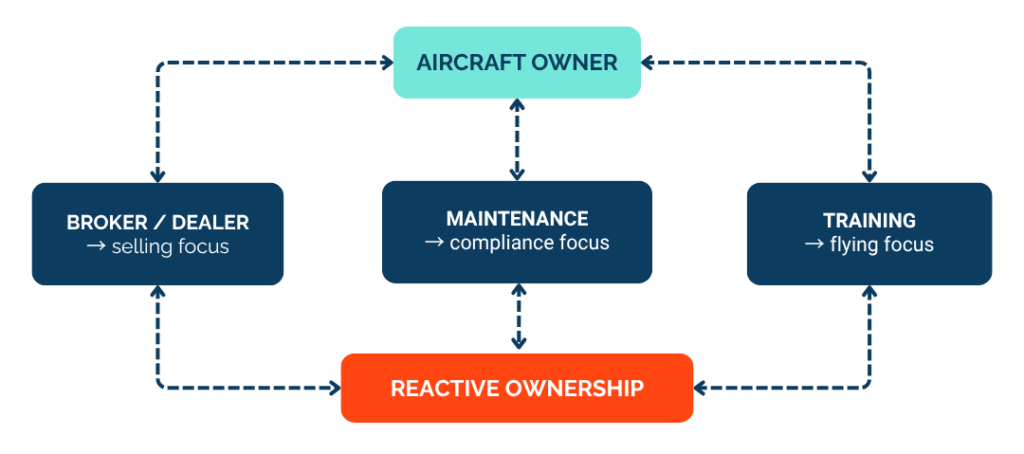
Aircraft ownership problems are often caused by misalignment and misunderstanding between stakeholders.
That is why it is critical for an aircraft owner to develop a solid technical understanding and actively manage ownership instead of letting it happen.
Every stakeholder has their own incentives.
Manufacturers, dealers, and brokers want to sell aircraft. Any aircraft they can make a profit on is relevant to them. It is not necessarily about finding the best aircraft for your mission.
Flight schools and instructors teach you how to fly legally and safely within their environment. They rarely teach you how to own and operate an aircraft professionally, economically, and long term.
Maintenance providers focus on compliance, liability, and revenue. Work is often done by the book. Parts are replaced when uncertain. This approach protects them and is commercially viable, even if it is not optimal for your ownership.
Across the industry, staff turnover is high. Knowledge is diluted. The aircraft owner often carries the consequences.
Sources of Complexity
It is not about blaming stakeholders. They act in their own best interest, as they should.
Aircraft ownership becomes more complex due to the nature of the industry itself.
General aviation is slow to evolve. Many aircraft designs are decades old. Even newer platforms are based on long-established concepts.
On the engine side, innovation has been limited. Some manufacturers introduced new approaches, but much of the market still relies on legacy systems. A classic example of the innovator’s dilemma.
Information is often fragmented or outdated. Manuals are not always aligned with current knowledge. At the same time, many pilots rely on long-standing beliefs and are reluctant to change.
This combination creates an environment where outdated practices and incomplete understanding influence decisions.
Where Problems Start
Aircraft ownership problems often start early.
One common issue is aircraft selection. The type may be popular, but the specific aircraft does not match the intended mission, usage, or preferences. Too much focus is placed on visible parameters such as total time or time since overhaul, without considering how the aircraft was actually operated.
Maintenance setup is another critical point. Choosing the wrong shop or failing to define clear expectations leads to reactive maintenance. No attention is given to condition monitoring or trend analysis.
Operational decisions also play a role. Without technical understanding, advice is followed without validation. Over time, this leads to avoidable issues.
Why Ownership Becomes Unpredictable
Things tend to go wrong when the basics are not set up correctly.
Aircraft ownership is an environment where no one is responsible for protecting your interests. If you do not define rules, expectations, and standards, decisions are made on your behalf.
Ownership becomes reactive. Things just happen, often not in your favour.
When Ownership Actually Works
Aircraft ownership becomes enjoyable when incentives and technical details are understood.
This can be achieved through years of trial and error. Or by applying structured systems, developing the willingness to improve, and working with a professional, independent, and evidence-based approach.
Conclusion
Aircraft ownership can be one of the best decisions you make. But it can also become frustrating and unnecessarily complex. The difference is not the aircraft alone. It is how you manage ownership.
Frequently Asked Questions
Many aircraft owners follow standard procedures, but still struggle because maintenance decisions often go beyond checklists. Recommendations can vary between providers, and standard approaches don’t always consider the specific condition or usage of the aircraft. Without the ability to interpret technical information independently, owners often rely on fragmented advice, which leads to uncertainty and reactive decisions.
Aircraft ownership becomes more complex because stakeholders such as brokers, flight schools, and maintenance providers operate with different incentives. Brokers focus on selling aircraft, training focuses on flying skills, and maintenance prioritizes compliance and liability. These misaligned incentives mean that no single party is responsible for optimizing ownership from the owner’s perspective.
Technical understanding allows aircraft owners to interpret maintenance findings, evaluate recommendations, and make more informed decisions. Without this understanding, owners depend heavily on external input, which can be inconsistent. A basic level of technical competence helps reduce uncertainty and improves long-term ownership outcomes.
Yes, much of the complexity in aircraft ownership comes from how it is managed, not from the aircraft itself. By introducing structure, improving decision-making processes, and using available data more effectively, owners can significantly reduce complexity and improve predictability without changing the aircraft.
Want to approach aircraft ownership with more structure?
About Quest Aeronautics
Quest Aeronautics is a state-certified engineering office for aviation, dedicated to shaping the future of general aviation by providing innovative and cost-effective solutions to enhance aircraft performance and operations. With a focus on CS/FAR-23 and experimental/amateur-built (E/A-B) aircraft, Quest Aeronautics provides a range of services including flight testing, aircraft operations and maintenance consulting, high-quality aviation products, and tailored support for E/A-B projects. Collaborating with industry-leading partners, Quest Aeronautics is committed to delivering unparalleled support and expertise to individuals and organisations in the general aviation market.
About Author
Sebastian, the founder of Quest Aeronautics, is a driven and enthusiastic individual with a passion for aviation. Before delving into aviation, he gained valuable experience as a chemical process engineer and laboratory technician. Sebastian holds a Master of Science in Engineering and a commercial pilot licence, with several fixed-wing aircraft ratings under his belt. He has also completed an introduction course for fixed-wing performance and flying qualities flight testing at the National Test Pilot School in Mojave, CA and is compliance verification engineer for flight.