
Stop Adding Fuel for Safety. It’s Quietly Damaging Your Engine, Your Wallet, and Your Passengers’ Safety.
Most pilot-owners are taught a simple rule: “When in doubt, go a bit richer.”
On Continental and Lycoming engines, that habit is one of the fastest ways to create fouled plugs, unnecessary carbon and lead build-up, and expensive maintenance you could have avoided. In extreme cases, this habit can cost you your aircraft and the lives of everyone on board.
Do not make the mistake of believing “rich equals safe.”
Prefer to watch instead of read?
The cost of “rich for safety” compounds across your aircraft ownership in terms of reliability, maintenance, and operating costs. The extra fuel burn over a 2,000-hour ownership period can easily add up to EUR 24,000 in fuel cost alone. Taking consequential damage and further optimisation into account, you are looking at EUR 56,000 to 112,000 in avoidable costs.*
*Based on a typical Lycoming IO-360 (200 HP), 167 hours/year, fuel €3.00/litre. Actual results vary by aircraft type, usage, and operating conditions.
If your aim is safety, which should be your primary goal, you need to aim for controlled temperatures and clean combustion, not adding fuel where it does no good and eventually harms your engine.
Ultimately, if you want to fully take advantage of aircraft ownership, you need to transition from “guy who owns a plane” to professional operator.
Why Is It Bad to Operate Your Engine Overly Rich?
“Richer always protects the engine” is wrong.
Rich is not a safety strategy. It is a setting with trade-offs and, over time, can damage your engine. There is no reason to operate the aircraft engine full rich except for cold starts and take-off power at standard day conditions near mean sea level where additional fuel is genuinely required for cooling, detonation margin, or power production, many piston engines are routinely operated significantly richer than necessary.
To understand why, we need to briefly discuss how your Continental or Lycoming engine actually works.
An internal combustion engine converts chemical energy into mechanical energy. This is done by burning fuel and air inside a closed combustion chamber. The air-to-fuel ratio (AFR), commonly called mixture, influences combustion quality, combustion temperature, internal cylinder pressure, and ultimately engine longevity.
The ideal air-to-fuel ratio for gasoline and air is 14.7:1 by mass. This is called the stoichiometric ratio, where all reactants are theoretically consumed and no excess reactants remain in the exhaust gas.
A higher air-to-fuel ratio is called lean. A lower ratio is called rich.
Why does this matter?
Because the mixture directly affects combustion temperatures, internal cylinder pressure, exhaust gas composition, and deposit formation inside the engine.
Depending on the air-to-fuel ratio and resulting temperatures, more or less carbon and lead deposits build up in the combustion chamber, on spark plugs, and around exhaust valves. This can lead to failed magneto checks, rough running, “morning sickness,” sticky valves, and in extreme cases catastrophic engine failures caused by pre-ignition or valve head separation.
In reality, “a little extra fuel” often masks bad techniques and bad instruction. It creates maintenance symptoms that then get “fixed” with parts swapping instead of correcting the root cause.
That keeps aircraft owners dependent on shops, folklore, and hangar talk instead of developing evidence-based operational control.
Operate the Engine Like a Professional Operator
The reality is that most pilots and aircraft owners do not fully understand what it means to lean an aircraft engine correctly, use advanced leaning concepts like the red box and red fin, or understand which temperature limits actually matter.
It is not entirely their fault.
Many learned to fly on Rotax/Diesel engines or were taught by instructors who were not as knowledgeable about operating Continental and Lycoming engines as they believed. Instead of using evidence-based data, they relied on outdated information, simplified rules of thumb, and folklore.
During one of our outreach conversations a while ago, I spoke with an aircraft owner who had multiple academic degrees in a technical field, including a PhD.
Obviously, a very intelligent individual. But he still approached aircraft ownership through the “default” path instead of approaching it like a professional operator.
He only had analogue engine instruments installed. One EGT and one CHT. He did not know the limits. He did not use proper leaning techniques but added five litres of fuel to “protect” the valves because that is what he had been told.
During the same conversation, he mentioned that he had crashed his previous aircraft into the ocean due to a catastrophic engine failure. The suspected cause was sticky valves or valve head separation.
He had a complete engine failure with passengers on board and still did not question whether his operating practices were correct.
That is the problem.
Rich of Peak vs Lean of Peak
Generally speaking, aircraft engines can be operated rich of peak or lean of peak.
Rich of peak is usually selected for best performance and higher speed. Lean of peak is generally used for best economy, lower fuel burn, cleaner combustion, and lower engine stress.
The problem is that many operators are not aware of the respective operating areas and simply run the engine close to full rich because it “feels safer.”
Let us briefly simplify the concept.
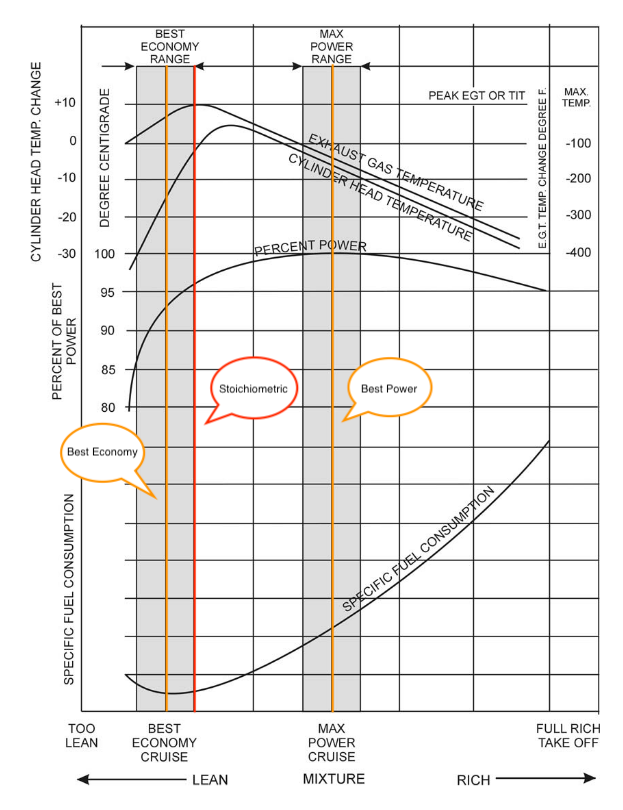
Exhaust gas temperature reaches its maximum near the stoichiometric ratio. That is why we refer to operating rich or lean “of peak.”
Cylinder head temperature and internal cylinder pressure both rise significantly around 25 to 50°F rich of peak, creating one of the highest stress operating regions for the engine. Historically, many operators spent large amounts of time in this region because it was associated with simplified “best economy” leaning practices.
This area should generally be avoided.
The area for best power is usually around 100 to 150°F rich of peak. This is selected when speed matters more than fuel burn and range.
The area on the lean side of peak is called lean of peak. It is generally selected when fuel burn, cleaner combustion, and lower engine stress matter more than absolute speed.
The area for best economy is generally around 25 to 75°F lean of peak.
It is also important to understand that cylinder head temperature is the best approximation we have in the cockpit for internal cylinder pressure.
Higher CHT generally means more stress on the engine.
You will also notice that reducing cylinder head temperatures when operating rich of peak often requires significantly more fuel compared to lean of peak operation where a little less fuel results in the same temperature change.
Your choice.
The important point is this:
You can directly influence:
- combustion cleanliness
- engine temperatures
- internal stress
- reliability
- operating cost
- engine longevity
And these things should be managed intentionally, not accidentally.
How Can You Improve Your Engine Operations Right Now?
Depending on your aircraft, equipment, and experience, there are several things you can improve immediately.
Step 1: Install an Engine Monitor and Focus on the Right Parameters
Install an engine monitor that displays and records:
- manifold air pressure
- RPM
- fuel flow
- cylinder head temperature for each cylinder
- exhaust gas temperature for each cylinder
- outside air temperature if possible
Define personal CHT limits. We generally recommend:
- max. 420°F for Lycoming engines
- max. 400°F for Continental engines
Use EGT to understand mixture behaviour, not as a “safety proxy.” EGT itself is generally not the limiting parameter. Always refer to the engine operator’s manual.
Pro-Tip: If your engine monitor records the parameters above, you already have the foundation for proper engine condition monitoring.
Step 2: Perform a Mixture Distribution Test
A key requirement for proper lean-of-peak operation is balanced fuel distribution across all cylinders.
This can be checked with a mixture distribution test, often called a GAMI lean test.
You basically check the fuel flow difference between the first and last cylinder reaching peak EGT. Ideally, the spread should be below one gallon per hour.
If the spread is larger and your engine is fuel injected, balanced injectors such as GAMIjector® can significantly improve mixture distribution.
You can also perform ignition stress tests and induction leak tests to better understand the condition of your engine.
You can download the procedures and test cards here:
Although these test procedures are not overly complex, I highly recommend using a safety pilot, briefing the tests properly, and adhering to the official manuals.
Step 3: Build a Repeatable Leaning Process
Follow the Pareto principle and focus on small changes with large impact.
As mentioned before, there is no reason to operate the engine full rich except for cold starts and take-off power near sea level under standard conditions.
Lean aggressively on the ground. At idle and taxi power settings, aggressive leaning does not damage the engine. It helps prevent harmful carbon and lead deposits.
Your goal should be consistency:
- start-up
- taxi
- run-up
- take-off
- climb
- cruise
- descent
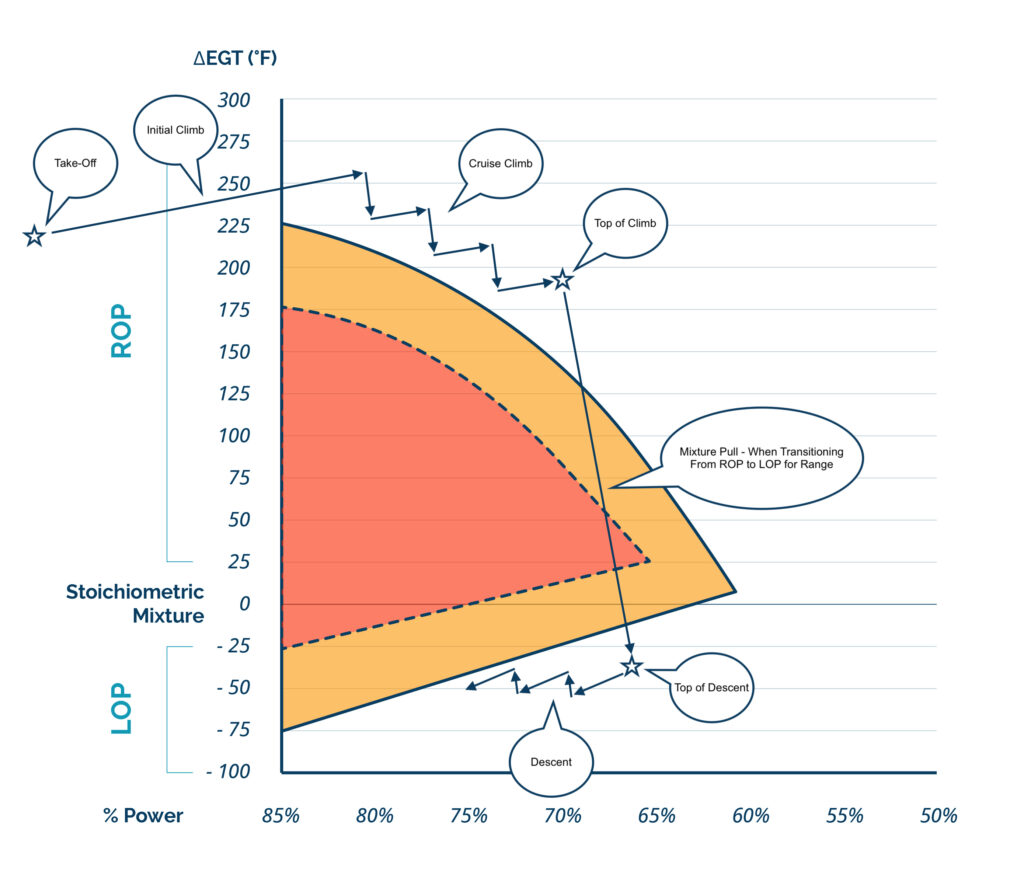
Eventually, you should develop a repeatable “phase of flight” leaning strategy like the red fin concept shown below.
That is a long-term goal and requires knowledge, experience, and discipline.
Why Can’t You Just Operate Like Everyone Else?
You can, but you probably do not want the same outcome as everyone else.
You want to operate intentionally, not simply repeat inherited habits.
I have written and talked extensively about industry incentives and information asymmetry, but for the purpose of this article let us consider two common objections.
Objection 1: “My Instructor Told Me Rich Is Safer.”
Many instructors teach simplified rules that reduce the risk of worst-case mistakes.
But simple is not the same as correct for your specific engine and operation.
Professional operation means transitioning from rules of thumb to data-backed techniques.
Additionally, many instructors are either very inexperienced or very experienced on completely different aircraft categories while still relying on outdated information.
Objection 2: “Engine Monitors Are Expensive and Complicated.”
Expensive compared to what? One cylinder issue? Repeated spark plug replacements? Unnecessary parts swapping? EUR 56,000+ in avoidable ownership leaks?
Complexity drops quickly when you focus on a few important parameters and trends.
And what is it worth to detect an issue before it becomes an in-flight emergency?
For me, that is worth every penny, especially when my loved ones fly with me.
Even highly intelligent and technically minded individuals get this wrong. Not because they lack intelligence, but because the system and information are asymmetric.
Eventually, you need to decide whether you want to lead or follow.
Stop Operating by Habit
“Adding a little fuel” feels safe because it is simple and familiar. But in reality, it often trades short-term comfort for long-term engine wear, dirty combustion, unnecessary maintenance, and avoidable cost.
Professional operators do not manage engines with folklore or rules of thumb.
They manage:
- temperatures
- fuel flow
- combustion quality
- trends
If you want reliability, safety, and lower lifecycle cost, you need to stop operating by habit and start operating by evidence.
Learn to Operate Like a Professional
If you want to operate your aircraft like a professional asset instead of an expensive hobby you hope behaves, we can help you implement a structured, evidence-based ownership system.
Inside our Aircraft Ownership Workshop and Pilot-Owner Academy, we help pilot-owners:
- set up proper engine condition monitoring
- understand and interpret engine data
- conduct and analyse in-flight test procedures
- build repeatable leaning and temperature management procedures
- reduce avoidable maintenance, uncertainty, and operating cost
Most aircraft owners are never taught how to operate and manage their aircraft properly.
That is exactly what we aim to change.
If you want to understand the system behind professional aircraft ownership, you can sign up for one of our workshops directly below.
Want to approach aircraft ownership with more structure?
Frequently Asked Questions
Lean of peak means operating the engine on the lean side of peak exhaust gas temperature to reduce fuel burn, combustion temperatures, and engine stress.
Engine monitors provide visibility into temperatures, fuel flow, and engine trends, allowing owners to operate more intentionally instead of guessing.
Cylinder head temperature (CHT) is one of the most important indicators because it closely relates to internal engine stress.
No. At low power settings during taxi and idle, aggressive leaning generally helps reduce lead and carbon deposits.
About Quest Aeronautics
Quest Aeronautics is a state-certified engineering office for aviation, dedicated to shaping the future of general aviation by providing innovative and cost-effective solutions to enhance aircraft performance and operations. With a focus on CS/FAR-23 and experimental/amateur-built (E/A-B) aircraft, Quest Aeronautics provides a range of services including flight testing, aircraft operations and maintenance consulting, high-quality aviation products, and tailored support for E/A-B projects. Collaborating with industry-leading partners, Quest Aeronautics is committed to delivering unparalleled support and expertise to individuals and organisations in the general aviation market.
About Author
Sebastian, the founder of Quest Aeronautics, is a driven and enthusiastic individual with a passion for aviation. Before delving into aviation, he gained valuable experience as a chemical process engineer and laboratory technician. Sebastian holds a Master of Science in Engineering and a commercial pilot licence, with several fixed-wing aircraft ratings under his belt. He has also completed an introduction course for fixed-wing performance and flying qualities flight testing at the National Test Pilot School in Mojave, CA and is compliance verification engineer for flight.